
Lev Prasov: Curious, Compassionate, Fascinated with Gadgets
Dr. Prasov and his team of researchers are tackling normal tension glaucoma—a particularly complicated form of the disease.

Growing up in St. Petersburg, Russia, young Lev Prasov was fascinated with gadgets. If it had buttons, wires, or moving parts, he wanted to figure out how it worked — and, more importantly, how it could be used to solve problems. That curiosity eventually led him to the University of Michigan, where he earned degrees in Chemistry and Biochemistry before diving into the prestigious Medical Scientist Training Program to earn both his MD and a PhD in Human Genetics.
Dr. Prasov went on to complete his ophthalmology residency at Michigan’s Kellogg Eye Center, followed by a specialized Ophthalmic Genetics Fellowship at the National Eye Institute within the National Institutes of Health (NIH). Today, as an accomplished clinician-scientist, he uses that elite training to take diseases apart at the molecular level to help solve complex visual problems.
In the clinic, Dr. Prasov brings that same problem-solving mindset straight to his patients. When asked what fuels his passion for glaucoma research, he reflects on how difficult it is to look a patient in their eyes and say, “We don’t know,” or “There’s nothing we can do.” For Lev, scientific research isn’t just an academic exercise; it’s about giving real answers—and real hope—to the people sitting in his exam chair.
That drive is at the heart of his latest project, supported by a Glaucoma Research Foundation Shaffer Grant. Dr. Prasov and his team are tackling normal tension glaucoma—a particularly frustrating form of the disease where vision loss continues even when intraocular pressure is well-controlled. Playing genetic detective, Dr. Prasov’s team recently discovered a novel gene tied to this condition that controls “chaperone proteins.” Think of these as strict chaperones at a school dance: their job is to keep order, help other proteins fold properly, and keep cellular traffic moving smoothly. When these chaperones malfunction, eye cells suffer stress and damage. By decoding this genetic glitch, Dr. Prasov is unlocking entirely new pathways for future treatments that go beyond standard pressure-lowering drops.
When he isn’t untangling DNA or seeing patients, Dr. Prasov steps away from the lab to recharge. You can usually find him showing off his backhand on the tennis court, working in his garden, traveling, or spending quality time with his partner and their dog.
By combining curiosity, world-class genetic training, and a doctor’s compassion, Dr. Lev Prasov is working to rewrite the glaucoma playbook—striving for a future where “we don’t know” is officially retired from the medical lexicon.
Questions and Answers with our August 2026 Scientist of the Month: Lev Prasov
Where were you born?
St. Petersburg, Russia
Where did you get your PhD?
University of Michigan
What first interested you in science?
I was first interested in science and ophthalmology when I was a young child. I was fascinated with technology and gadgets, and loved the idea of using these to solve problems.
What is your personal motivation as a scientist?
In my clinical practice, one of the hardest things to say to a patient is “we don’t know” or “there is nothing we can do.” As a scientist, my motivation is to help understand disease mechanisms, so that I can help better inform my patients and work towards improving treatments for them. This provides hope to my patients and a sense of purpose to our research efforts.
What is the goal of your Shaffer research project?
We recently identified a new gene in a large family with normal tension glaucoma and high myopia. In this family, members have continued vision loss despite well-controlled eye pressures. The goal for this proposal is to establish our new gene (which acts as a chaperone protein) as a disease gene for glaucoma, identify if other chaperone complex members contribute to genetic forms of glaucoma, and show how genetic variants in these genes lead to cellular dysfunction ultimately leading to glaucoma.
How could your Shaffer research impact glaucoma patients?
Validation of this new gene would open up new molecular pathways to target for glaucoma and allow better risk assessment as well as identify new targets for therapy.
When you’re not in the lab, what do you do for fun?
I enjoy playing tennis, gardening, traveling, and spending time with my partner and my dog.
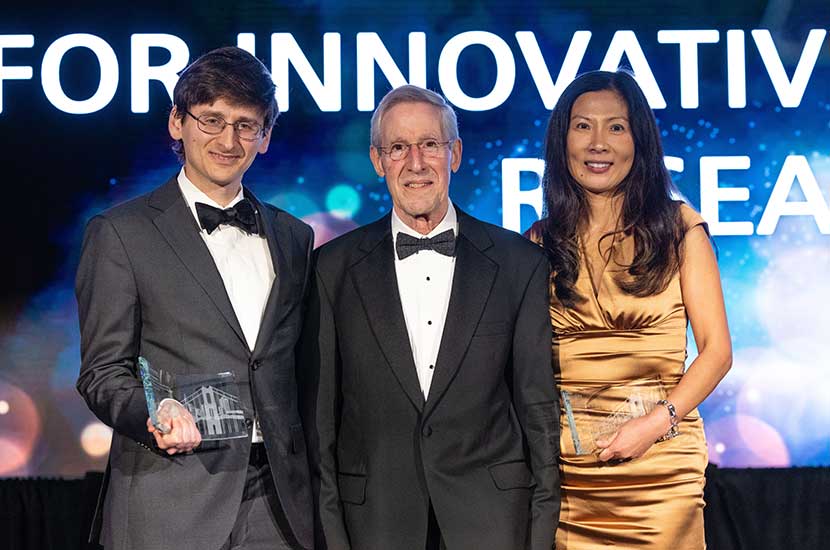
Pictured above: GRF president and CEO Thomas Brunner (center) awarded the 2023 Shaffer Prize for Innovative Glaucoma Research to both Lev Prasov, MD, PhD and Rachel Wang Kuchtey, MD, PhD.
Posted on August 11, 2026. Article by Cynthia Steel, PhD, MBA.

Cynthia Steel, PhD
Cynthia Steel, PhD is the Chief Scientific Officer for Glaucoma Research Foundation. Her work is grounded in a commitment to improving patient outcomes and translating cutting-edge science into meaningful clinical applications.